
Most workplace decisions start with incomplete information.
A floorplan tells you what space exists.
A booking system tells you what someone intended to use.
A headcount tells you how many people could arrive.
But if you need to understand how the workplace is actually being used, sometimes you have to go and look.
Traditional occupancy studies can provide that evidence — but managing floorplans, survey routes, forms, spreadsheets and thousands of individual observations quickly becomes difficult.
SiteIQ Schematic makes the study digital from the start.
First, we build your workplace.
SiteIQ takes your existing floorplans and creates a digital model of the areas being studied. Depending on the study, that can include:
Each space has its own identity within the study, so observations are recorded against the actual workplace rather than reconstructed later from spreadsheets.
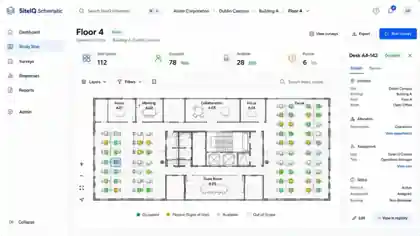
Then you measure what is happening.
The study is configured around the question you need to answer. SiteIQ defines the spaces, observation types, survey schedule and capture rules.
Surveyors then walk the workplace at agreed times and record what they see directly against the digital twin. For example:
Or simple occupancy counts for rooms and other spaces. The survey can be configured differently depending on what needs to be measured.
Simple enough to use while walking the building.
Surveyors use a phone or tablet to move through the workplace and capture observations.
Time and location context are already built into the study, helping keep data consistent across surveyors, locations and observation rounds.
Capture can continue where connectivity is limited and synchronise when a connection is available.
Your people can survey. Or ours can.
Not every occupancy study needs an external survey team.
Your nominated people conduct the observations. SiteIQ builds the digital twin, configures the study, defines the survey method, briefs the surveyors and supports the study.
SiteIQ provides the survey team and manages the fieldwork as well as the technology and analysis.
SiteIQ supports priority locations while your people survey other buildings or sites using the same digital study.
One platform. One methodology. One consistent dataset.
See the study while it is happening.
Occupancy studies can involve thousands of observations across multiple surveyors and locations. SiteIQ Schematic gives the study manager a clear view of progress.
Instead of discovering problems when the study is over, the study can be managed while it is running.
Turn thousands of observations into a clear picture of use.
Once the study is complete, SiteIQ turns the captured data into evidence about how the workplace is being used. Understand:
SiteIQ's previous workplace studies have already used this type of analysis to examine active, passive and empty desks, peak occupancy, area-by-area usage and day-of-week patterns.
Not every occupancy question is about a desk.
The digital twin and study can be configured around the environment and the decision being made.
Understand active use, passive occupation, availability and patterns across the working week.
See which spaces are genuinely being used, how often and at what times.
Measure room occupancy and utilisation across buildings, faculties and time periods.
Understand demand across common areas and other shared facilities.
Capture utilisation snapshots and identify peak demand or available capacity.
The model is flexible because the study is built around spaces and observations, not one fixed survey type.
Useful wherever space decisions need evidence.
Before increasing capacity, reducing space, refurbishing offices or changing workplace policy.
To understand how classrooms, lecture theatres, study spaces and other campus facilities are actually being used.
To add structured occupancy studies to client services using a repeatable digital method.
To gather consistent field evidence without building a new survey process for every project.
To understand usage and capacity across distributed offices and facilities.
Sometimes you need evidence. Not permanent infrastructure.
Sensors are valuable when continuous monitoring is required. But continuous monitoring is not always necessary.
If the question is:
a structured occupancy study may provide the evidence you need without installing permanent monitoring hardware throughout the estate.
And if longer-term monitoring is required later, the study helps identify where it is actually worth deploying.
Make workplace decisions from observed evidence.
Understand what is happening in the workplace rather than relying only on plans, bookings or assumptions.
Identify spaces that may already have room for more demand.
See where and when pressure actually occurs.
Apply the same study method across floors, buildings and sites.
Capture observations directly against a structured digital workplace model.
Spend less time combining forms, notes, floorplans and spreadsheets after the fieldwork is complete.
Understand the workplace before deciding what to change.
SiteIQ Schematic creates a point-in-time evidence base for how your workplace is being used.
SiteIQ Workplace provides the ongoing operational layer for managing workplace capacity, resources, allocation and availability.
Workplace Intelligence is the service around all of this — SiteIQ's consulting team scoping, running and interpreting studies, and deploying permanent IoT sensors where continuous monitoring is warranted. Schematic is the software those studies run on, and it is equally available to your own team.
A study may show that nothing needs to change. Or it may reveal hidden capacity, allocation problems, areas of pressure or a need for more active workplace management.
Either way, the decision starts with evidence.